Nvidia's unreported China business: about $5bn a quarter, and on our central estimate most of it is not smuggling
Nvidia booked $11bn of sales to Chinese customers last quarter. Chinese labs also run on Nvidia chips that are counted elsewhere: rented in data centres abroad or smuggled in. We put that unreported demand at about $5bn a quarter, roughly 4% of revenue. New US rules now target it.
Nvidia's latest results say customers headquartered in China and Hong Kong bought $11.05bn of its products in the quarter to 25 October, 9.5% of its $115.8bn of revenue [1]. Its outlook for the current quarter assumes no data-centre computing revenue from China at all, which takes out the $2.4bn of licensed Hopper chips it shipped there last quarter [2].
That reads like the end of Nvidia's China story. It is not, because the China figure counts who Nvidia sells to, not where its chips end up.
Booked somewhere else
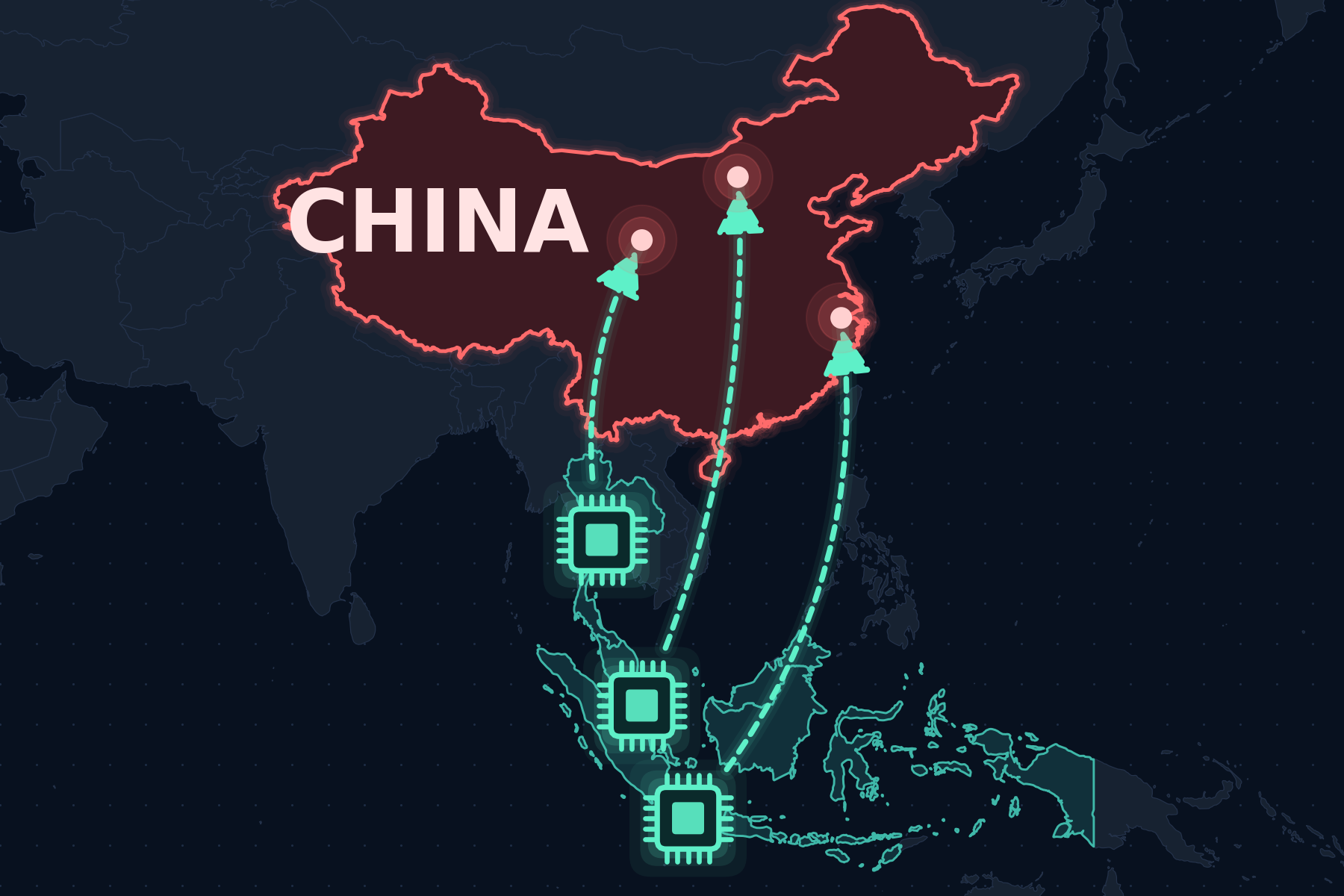
Nvidia reports revenue by the headquarters of its direct customer: a server maker, a cloud company or a distributor [3]. A chip sold to an American or Taiwanese server maker, installed in Malaysia and rented to a Chinese AI lab, counts as American or Taiwanese revenue. So does a chip bought for a data centre in Southeast Asia and then carried across the border into China.
The first route, renting abroad, was largely outside US controls until this week, although Washington now says that chips for a site rented mostly to a Chinese firm already needed a licence [4]. A White House official has accused Moonshot AI of using Nvidia's GB300 chips through a facility in Thailand, and ByteDance has reportedly used Nvidia clusters in Malaysia [5]. The second route, smuggling, breaks the export rules outright.
On 16 November the US Commerce Department released a rule aimed at both. It takes effect when it is published in the Federal Register, scheduled for 19 November. Shipping advanced chips to any data centre, anywhere, that sells more than a set amount of computing to Chinese-headquartered companies will need a licence. So will shipping them to Indonesia, Malaysia, Singapore, Thailand and Brazil, unless the buyer is headquartered in the US and the exporter reports each shipment monthly. Data centres already serving Chinese firms get 90 days to obtain a licence [4].
How big is it?
Our central estimate is that rented capacity abroad brings Nvidia about $3.1bn a quarter and smuggling about $2bn, or about $5.2bn together [2, 6, 7, 8]. That is about 4% of the roughly $121bn per 13 weeks implied by Nvidia's guidance of $130bn for a 14-week quarter, and about half the size of the China line it does report. The plausible range is wide, from 1.5% to 13% of revenue, and some front companies may be counted in both columns, so if anything the total is too high.
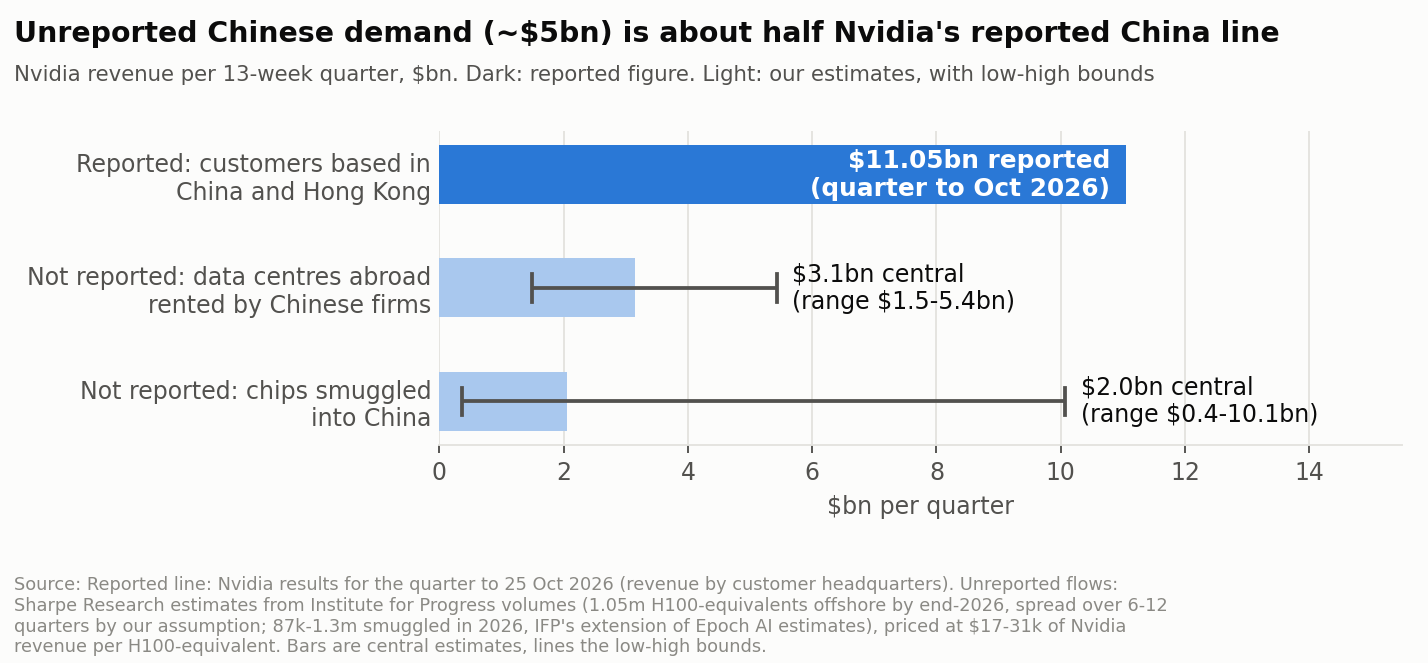
The volumes come from the Institute for Progress, a Washington think tank that argues for tighter chip controls. It estimates that about 1.05m H100-equivalents of capacity abroad will be open to Chinese firms by the end of 2026. Extending Epoch AI's smuggling estimates, it puts this year's smuggling at about 341,000, within a range of 87,000 to 1.3m [6]. We turn those into revenue using what Nvidia says its revenue opportunity is per gigawatt of data centre [7]. Both steps are rough, which is why the range is so wide.
Blackwell in Chinese models: four labs, few chips
The strongest new evidence came on 12 November. An independent researcher at Unemployment Labs found a numerical fingerprint of Nvidia's Blackwell chips in six Chinese models released since April, from DeepSeek, Moonshot, MiniMax and Ant Group [8]. These Blackwell data-centre chips need a US export licence for China, and none has been reported [8, 9]. In February a senior US official said DeepSeek had trained on Blackwell, with the chips likely clustered at a data centre in Inner Mongolia. The official did not say how it got them and published no evidence [9]. Documents seen by Bloomberg describe a Moonshot contract from August to lease 32 Blackwell Ultra servers stored in Gansu, valued at about 350% above American prices; Moonshot denies it [10].
So four leading Chinese labs appear to have had Blackwell access. The same researcher found that the newest models from Alibaba, Zhipu, Tencent, Xiaomi and StepFun still read as trained on older Hopper chips [8]. And access is not the same as a large share of Nvidia's sales. The researcher says the fingerprint supports, without proving, that Blackwell did the training, and cannot show where the chips sat. The training runs it found were also small in money terms. The two largest needed about 4,500 and 3,000 Blackwell chips, or 8,000 to 9,000 on a less favourable assumption. The biggest cluster cost an estimated $200m-300m all-in, and the five together more than $0.5bn [8]. On the report's own chip count, the five come to about $0.8bn, under 1% of one quarter of Nvidia's revenue. The researcher adds that the labs' total spending on these chips is likely in the billions.
The runs found took thousands of chips. For smuggling alone to reach 10% of Nvidia's revenue, about 2m H100-equivalents would have to cross into China every year. That is about six times the central estimate and above the top of every published range [2, 6, 7, 8].
Data centres that may not be what they seem
There are also allegations that some data centres abroad were fronts whose chips went to China. The best-known case is Megaspeed, a Singapore firm. Bloomberg's analysis of customs records shows at least 136,000 Nvidia chips, worth at least $4.6bn, going into Malaysia and Indonesia, while Nvidia's own audit reportedly could not find about 50,000 of them [11, 12, 13]. A US inspection in late 2024 reportedly found servers that should have been running still sealed in crates [13]. Nvidia says later checks of other Megaspeed warehouses found the missing hardware, but has not said how many chips. Megaspeed has categorically denied the allegations and says inspections found no evidence of illegal chip transfers. Nvidia says the claims were investigated and debunked [11]. Malaysia's trade ministry has rejected claims that it cleared the firm, saying its visits were routine monitoring [13, 14].
Trade statistics fit the same pattern, though Epoch AI, which compiled them, stresses that they do not prove diversion. Between April 2024 and June 2025 China recorded $3.8bn of server imports from Malaysia, while Malaysia recorded only $0.6bn of server exports to China. The flow collapsed within weeks of Malaysia requiring permits for such exports in July 2025 [15].
If such fronts are real, they do not add to our total. They move money from the "rented abroad" column to the "smuggled" one. They also suggest that the peak came in 2024-25. China's recorded server imports from Malaysia and Singapore fell by about 82% in value between the first halves of 2025 and 2026, according to the Institute for Progress [6]. Smuggling has not stopped, as Blackwell Ultra servers stored in China in August suggest, if the documents are right. On our reading it has shrunk.
What the new rule puts at risk
The new rule targets the roughly $5bn directly, but Nvidia will not lose all of it. Licences are decided case by case, and while Nvidia's chips are in short supply, sales blocked in one place tend to go to buyers elsewhere. After the October 2023 rules, Nvidia said lost sales to China and other affected countries would be "more than offset" by growth elsewhere [16]. On the unreported flows alone, our central estimate is a loss of about 1.5% of revenue in the first quarter, falling to about 0.5% once the chips are resold. Adding possible Chinese retaliation against the sales Nvidia does report as China, and licence delays for other buyers in the region, gives about 2.4% and 1.3% [2, 4, 17, 18].
History also carries a warning. After the 2023 rules, a smuggling route through Malaysia opened within months [15]. Epoch's smuggling estimates then rose from about 159,000 H100-equivalents in 2024 to about 480,000 in 2025, roughly in step with chip production [6]. If renting abroad becomes hard, some Chinese demand may move into front companies again. That would keep it inside Nvidia's revenue for a while longer, at greater legal risk.
What would change the picture
Three things would sharpen these numbers: an official count of diverted chips from the US Justice or Commerce departments, the outcome of the Megaspeed investigations, and Nvidia publishing again where the end customers of its Taiwanese buyers sit. It gave that figure in its annual report for the year to January 2026 [19] and has left it out of its quarterly reports since [3].
Sources
- NVIDIA Corporation (2026). NVIDIA Supplemental Financial Information for the quarter ended October 25, 2026 (Form 8-K exhibit). SEC EDGAR. Accessed 2026-11-17.
- NVIDIA Corporation (2026). NVIDIA CFO Commentary on Third Quarter Fiscal 2027 Results (Form 8-K exhibit). SEC EDGAR. Accessed 2026-11-17.
- NVIDIA Corp (2026). NVIDIA Corp Form 10-Q for the quarter ended July 26, 2026. SEC EDGAR. Accessed 2026-11-12.
- Bureau of Industry and Security, U.S. Department of Commerce (2026). Addressing Remote Access to Advanced Semiconductors (interim final rule, RIN 0694-AK50; Federal Register public-inspection copy, FR doc 2026-23529). Federal Register (public inspection). Accessed 2026-11-18.
- Kai Nicol-Schwarz (2026). China AI firms tap Nvidia power overseas as U.S. weighs crackdown. CNBC. Accessed 2026-11-18.
- Tim Fist, Georgia Adamson, Konstantin Pilz (2026). How to Increase America's AI Lead Over China: Existing federal authorities could be used to double the current lead by the end of 2027. Institute for Progress. Accessed 2026-11-18.
- NVIDIA Corporation, FactSet CallStreet (2026). NVIDIA Q2 FY2027 earnings call, corrected transcript (26 Aug 2026). NVIDIA investor relations (q4cdn). Accessed 2026-11-15.
- Will DePue (2026). Top Chinese Frontier AI Models Carry the Fingerprint of Export-Controlled NVIDIA Blackwell GPUs. Unemployment Labs. Accessed 2026-11-18.
- Reuters (2026). US says China's DeepSeek trained AI model on Nvidia Blackwell chip despite export ban (Reuters, via Malay Mail). Malay Mail (Reuters wire). Accessed 2026-11-18.
- Seoul Economic Daily (2026). Banned Blackwell Chips Reach China Through Gray Market. Seoul Economic Daily (English edition). Accessed 2026-11-18.
- Vinay Patel (2026). Inside Megaspeed: The Little-Known Firm Linking Jensen and Alice Huang to Nvidia's $4.6B Chip Mystery. Tech Times UK (relaying Bloomberg and The Business Times). Accessed 2026-11-18.
- Erich Grunewald (2026). What's going on with Jensen Huang, Megaspeed, and export controls?. The Substrate (Substack). Accessed 2026-11-18.
- Anton Shilov (2026). Bain Capital's data center unit removes disgraced tenant suspected of smuggling Nvidia GPUs to China. Tom's Hardware. Accessed 2026-11-18.
- Jan Yong (2026). Malaysia 'never cleared' Megaspeed and Speedmatrix: MITI. w.media. Accessed 2026-11-18.
- Isabel Juniewicz (2026). Trade data is consistent with more than $3 billion of chips smuggled into China via Malaysia. Epoch AI (Data Insight). Accessed 2026-11-18.
- NVIDIA Corporation (2023). NVIDIA CFO Commentary on Third Quarter Fiscal 2024 Results (Form 8-K exhibit). SEC EDGAR. Accessed 2026-11-17.
- Axios (2026). Nvidia's earnings mark start of post-Jensen era. Accessed 2026-11-18.
- Matteo Crosignani, Lina Han, Marco Macchiavelli, André F. Silva (2025). Securing Technological Leadership? The Cost of Export Controls on Firms (NY Fed Staff Report 1096; first circulated as 'Geopolitical Risk and Decoupling: Evidence from U.S. Export Controls'). Federal Reserve Bank of New York. Accessed 2026-11-18.
- NVIDIA Corporation (2026). NVIDIA Form 10-K for fiscal year ended January 25, 2026. SEC EDGAR. Accessed 2026-11-12.