Nvidia's 'avalanche': did Jensen Huang's supply bets force the company to bankroll its customers?
Since Huang's resignation, a story has spread that he locked in cheap, decade-long chip and memory contracts and then had to fund data centres to sell the output. The commitments are real and enormous. The decade, the cheap prices and the neat chain of cause and effect are not in the record.

Jensen Huang resigned as Nvidia's chief executive on 11 November, forced out by his board after a scandal over his ties to a suspected Chinese spy and an affair with an Nvidia executive [1, 2]. Colette Kress, the chief financial officer, is now interim chief executive [3].
Two days after he left, the Wall Street Journal described a meeting in August at which Huang told his finance team that the chip wafers and memory Nvidia had committed to buy were coming at him "like an avalanche" [4]. The same report said Kress had questioned some of his dealmaking, including Nvidia's habit of financing its own customers [4]. The avalanche line has since been spun into a bigger story online [5, 6]. It goes like this. When memory and foundry capacity began to get expensive in mid-2025, Huang used his friendships with the bosses of TSMC, SK hynix and Micron to lock in cheap prices on as much capacity as they would sell him, for a decade, before anyone else could. Then the supply arrived. To move it, he went to anyone with a plan for a data centre and offered money and a guaranteed customer. Nvidia's financing of its own buyers, on this telling, was the price of Huang's supply gamble.
It is a tidy story. Parts of it are true. Checked against Nvidia's filings, its suppliers' disclosures and the published reporting, most of the rest does not hold up. Which parts are true matters now, because the man who made the deals has gone, and the question is whether Nvidia can still sell everything it has promised to buy.
The part that is true: the commitments are enormous
Nvidia does owe its suppliers a staggering amount. Its commitments to buy supply and capacity rose from $119bn to $279bn in the three months to 26 July 2026 [7, 8]. A year earlier the figure had been about $30bn, where it had sat since the start of 2025; it then climbed to $50bn in October 2025, $95bn in January and $119bn in April [9, 10, 11, 12, 13]. The company says the money is "primarily" for memory and manufacturing capacity [7].
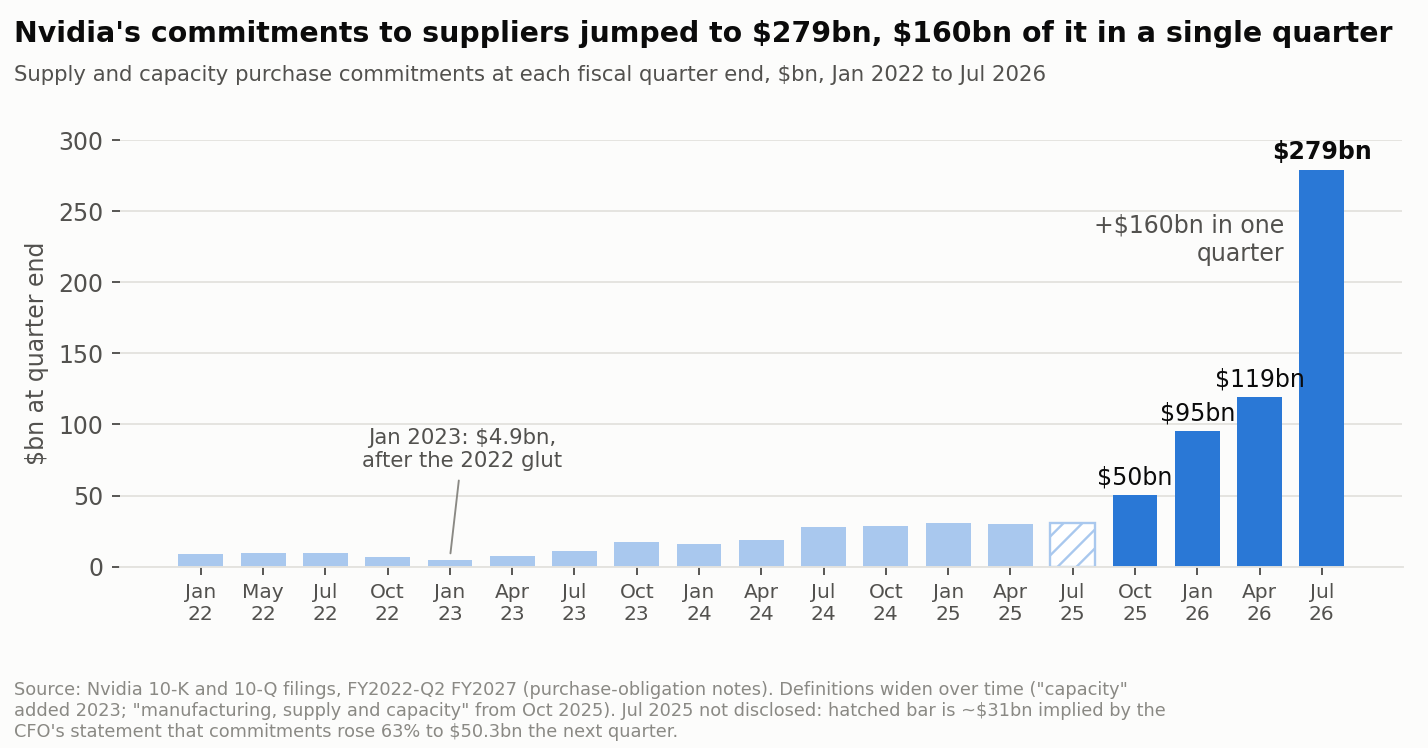
Measured against sales, this is new territory. The commitments now equal about 92% of a year's revenue. Before the 2022 glut in gaming and data-centre chips, Nvidia's last demand-driven glut, they peaked at about a third [7, 14, 15, 16, 17]. Nor can Nvidia easily walk away. It says the agreements can be cancelled, rescheduled or adjusted only "in certain instances" before firm orders are placed, and that changes may cost extra [7, 13]. Memory makers are increasingly signing multi-year take-or-pay contracts backed by deposits: Micron collected $12.75bn of such deposits this year [18], and SK hynix says it has signed long-term deals, typically for five years, with about ten customers [19].
Not a decade
The timetable is where the story starts to fray. Nvidia's latest quarterly filing shows when the $279bn is due: $92bn by January 2027, $87bn in the following year and $88bn in the year after that. Only $12bn falls due after January 2029, and just $1bn after early 2031 [7]. Kress has said the biggest parts fall in the first three years [20].
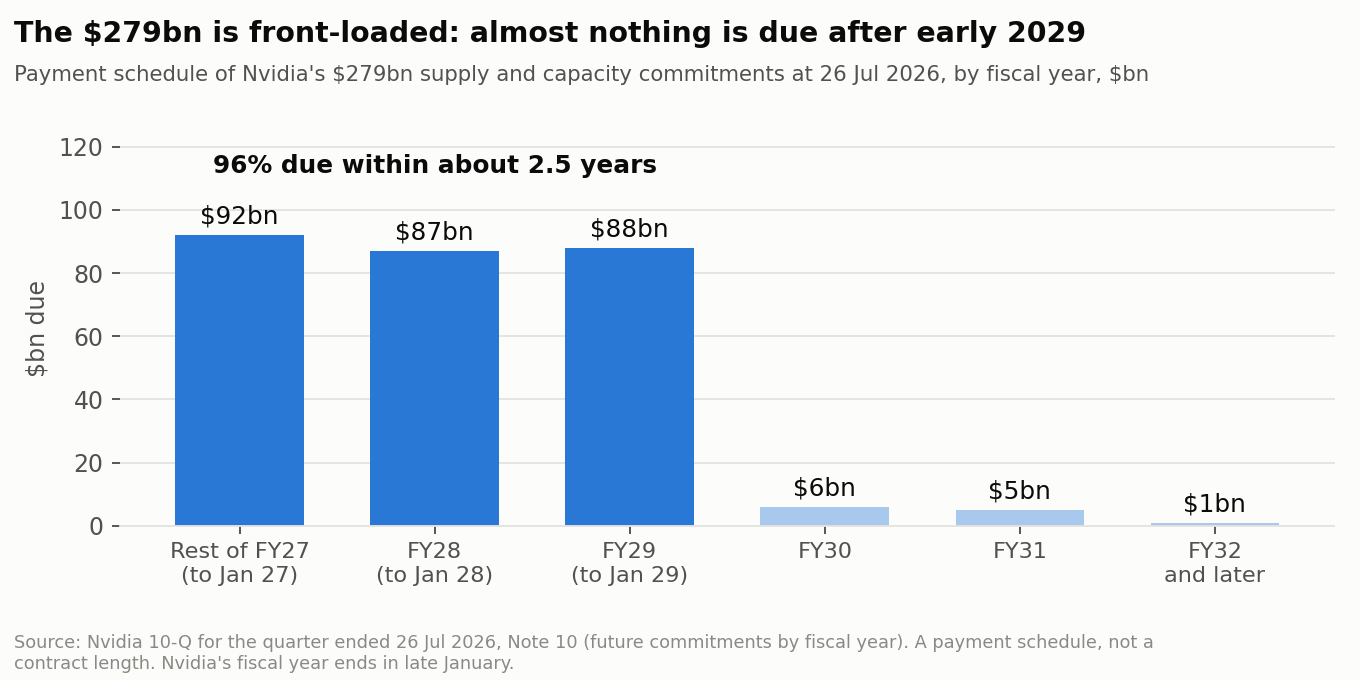
A payment schedule is not quite the same thing as a contract's length. But when 96% of the money is due within about two and a half years, the commitment is, in substance, a two-to-three-year bet, not a ten-year one. Nvidia's genuinely long obligations sit on the other side of the business, with its customers. It has agreed to buy CoreWeave's unsold cloud capacity until April 2032 [21], and its guarantees for the Ohio data-centre campus leased by OpenAI sit behind 20-year leases [7].
No sign of cheap prices
Nobody, as far as we can find, has published the prices in Nvidia's supply contracts. No filing or supplier discloses the counterparties, prices or terms behind the $279bn. What is on the record points the other way.
Start with Nvidia's own margins. Last November Kress warned that input costs were rising [12]. In August she spoke of "extreme pricing conditions in memory" and said gross margin, 75% that quarter, would fall to a low of 71-72% [20]. That is not how a company sitting on years of below-market memory talks. The suppliers, for their part, are setting floor prices high: Micron says even the minimum prices in its new long-term deals imply margins above any previous cycle's peak [18]. SK hynix was reported to be charging Nvidia more than 50% more for its newest high-bandwidth memory, HBM4, than for the previous generation, though that is a new product and the report rests on anonymous sources [22, 23]. TSMC is said to be planning wafer price rises for 2027 [24].
The timing does not fit either. Nvidia's commitments were flat through July 2025 and only began rising in the autumn. The great leap, $160bn in a single quarter, came between May and July 2026. By then ordinary memory-chip contract prices had already risen by roughly half in late 2025 and almost doubled again in early 2026 [7, 25, 26]. Two days before that quarter ended, Nvidia and SK Group announced letters of intent, usually not binding, on long-term memory supply [27].
There is a kernel of truth here. Huang said last November that Nvidia negotiates "well in advance" and had "secured a lot of supply" [12]. High-bandwidth memory, the kind that goes into Nvidia's accelerators, is priced on annual contracts, and industry research suggests it has earned memory makers far less than ordinary chips during this year's price spike [28]. So Nvidia very probably paid less than the soaring spot price for some of its 2026 memory. Any big contract buyer does that in a price spike. It is a long way from cheap prices locked in for years, and next year's high-bandwidth memory contracts are expected to be repriced sharply higher [28].
Did the supply drive the financing?
This is the heart of the story, and the hardest part to settle.
The Journal's account of what Nvidia was doing is detailed. From the spring of 2026 the company offered credit support to young cloud providers and data-centre developers in return for a share of their revenue, and dozens lined up [4]. The August meeting was called, the paper says, because Nvidia was in talks to guarantee billions of dollars for companies that could not afford its chips [4]. Kress questioned how the deals were chosen, how the guarantees were valued and what they would earn [4]. According to people familiar with the matter, she cut Nvidia's initial commitment to OpenAI in half [4, 29]. In July the paper had reported a $250bn backstop under consideration; the guarantee Nvidia signed carries a cap of $105bn [4, 29]. In the days that followed, Huang asked his staff for a way to judge guarantees that would count the chip sales they could bring [4]. Some deals were paused in late August, and by October, the paper says, Nvidia "started to turn off the tap" [4].
What the Journal does not do is connect the supply problem to the financing programme. It places both in the same meeting, alongside Huang's complaint that the big cloud companies were moving to rival chips. It does not say one caused the other [4]. One aim it gives for the credit support is turning upstart buyers into long-term customers [4]. The causal link is the commentators' addition.
That does not make it wrong, and the case for it is stronger than its critics might like. Huang named both problems in one breath. Guaranteeing buyers who cannot afford your product is what a seller does when supply runs ahead of demand that can pay. Some of the timing fits: in the same quarter as the $160bn jump in commitments, Nvidia introduced a new model of six-year deals to buy back cloud capacity, worth $36bn, and in August it signed the $105bn OpenAI guarantee [4, 7, 17, 29]. Its stock of raw materials nearly tripled in the first half of the year [7]. And $267bn of supply bills fall due over the next two and a half years, $92bn of them by January [7]. Somebody has to buy what those bills pay for. Nvidia itself says that many AI cloud firms and model makers cannot get long-term contracts or investment-grade financing, and that its guarantees are meant to fill the gap [7].
The case against is at least as strong. Some of the backstops came first. Nvidia's multi-year cloud agreements date back to late 2022, when they were described as supporting its own cloud service and research, and the CoreWeave deal was signed in September 2025, before most of the supply commitments existed [7, 17, 21]. The company is not drowning in unsold stock: it expects revenue to grow by about 70% next year and says supply is still the bottleneck [7, 20], and its inventory equals 119 days of cost of sales, against 212 at the depth of the 2023 glut [7, 14]. Multi-year take-or-pay memory deals have become common for big buyers [18, 19], so a jump in Nvidia's commitments does not require a singular gamble by its boss. And in October, according to the Journal, Huang told a table of cloud bosses a parable about a soup seller who will not sell all his soup to one or two customers, keeping his prices high and his clientele broad [4]. That sounds like a company protecting its pricing power and its independence from a handful of giant buyers, not one trying to dump surplus.
Our reading is that both motives were probably at work. Nvidia needed its smaller customers funded, and it needed buyers for output it had already promised to pay for. But on the published evidence, we put the chance that over-commitment was the main driver at only about 25-35% [7, 18, 20, 30].
Two other claims
The report that Nvidia has asked TSMC to wind down its orders, and that TSMC refused, rests on one Taiwanese newspaper article citing unnamed sources, which said only that Nvidia may slow its orders, with no size or timing. Neither company has commented, and no report we found says TSMC said no [31, 32].
A widely shared figure of "$530bn in guarantees" mixes up six different items. Nvidia's guarantees come to $108.5bn; the supply commitments are the $279bn [7, 33].
What changes without Huang?
This is where the story matters most. Huang was the dealmaker. According to the Journal, he launched the spree of credit-support deals, two of his vice presidents told would-be partners they could be arranged within a couple of weeks, and he wanted guarantees judged partly on the chip sales they would bring [4]. Kress was the one asking how the guarantees were valued and what they would earn, and she reportedly halved the initial commitment to OpenAI [4, 29]. If she is less willing to back marginal buyers, some of the smaller cloud companies that were counting on Nvidia's support may buy fewer chips, just as $267bn of supply bills come due [7].
That matters more than it might seem, because those customers are a big and fast-growing part of the business. Nvidia's segment for neoclouds, industry and enterprise brought in $40bn of its $96bn of revenue in the quarter to July, up 138% on a year earlier, and Kress said growth in the current quarter would be driven mainly by it [7, 20]. Add Huang's complaint that the big cloud companies were turning to rival chips [4], and a cooler attitude to financing the edge could bite.
There are good reasons not to overstate it. The retreat began under Huang. By the Journal's account he was already starting to wonder whether the spree had gone too far; deals were paused in late August, and by October, still under Huang, Nvidia "started to turn off the tap" while he told cloud bosses he wanted high prices and a broad customer base [4]. Kress has also defended the programme in public: "some will call this circular financing," she said in August. "We see it differently" [4]. The deals already signed, including the CoreWeave capacity guarantee, the $36bn of cloud buy-backs and the $105bn OpenAI guarantee, are contracts that do not lapse with a change of chief executive [4, 7, 17, 21, 29], and the board has said customer commitments will continue [3]. Nvidia is also trying to move the financing off its own balance sheet: in August it signed preliminary agreements with large capital providers to raise more than $500bn of outside money for its customers' build-outs [7]. And the biggest buyers, the hyperscale cloud companies, still account for about half of revenue, $49bn last quarter [7, 20]. They do not need Nvidia's guarantees, though Nvidia does give some investment-grade buyers up to a year to pay for large builds [7]. Management still says supply, not demand, is the bottleneck [7, 20].
Our reading is that the risk sits at the edge, not the core. A more cautious Nvidia is likely to finance fewer small cloud firms, and some of those firms will struggle to buy as many chips. Whether that leaves Nvidia with unsold supply depends on whether the large buyers who pay their own way, and any outside lenders that replace Nvidia's credit, take up the slack. If they do, a tighter credit policy costs Nvidia some customers but not its order book. If the big buyers also slow, or move faster to rival chips, the $279bn becomes a real problem. The first test is the outlook Nvidia gives with its third-quarter results.
What if the bet goes wrong?
History offers a rough yardstick. After the 2022 slump, Nvidia took $1.13bn of charges for purchase commitments it no longer needed, about 12% of what it had committed at the peak [17]. Cisco's write-down in 2001, after the telecoms bust, came to about 10% of a year's sales [34]. A similar hit on today's $279bn would cost something like $28bn-33bn. That is only an illustration, and a loose one, since Cisco's figure is a share of sales rather than of commitments. It would be painful but survivable: Nvidia generated $74bn of operating cash in the first half of this financial year alone [7].
Two things make today riskier than 2022. The commitments are about 2.8 times larger relative to annual revenue than they were then, though the comparison is approximate because the 2022 figures did not yet include capacity commitments [7, 14, 15, 16, 17]. And if Nvidia's contracts look like the take-or-pay deals its suppliers describe, they will be harder to unwind [18].
Much is still unknown. Nvidia does not say who its suppliers are or what it pays them, and no supplier names Nvidia among its long-term customers. Whether Nvidia is really cutting orders at TSMC is unconfirmed. Our reading of the Journal's article comes from a syndicated copy dated 13 November, which may have been revised since. The next clue arrives with Nvidia's third-quarter filing, due around 17-19 November: it will show whether the commitments are still rising and whether the guarantees are shrinking.
Claude Opus 5.5, an AI model made by Anthropic, was used to help research and write this article. Nvidia, Micron and TSMC, all discussed here, have agreed to buy Anthropic shares in a private placement alongside its IPO [35]. This is analysis, not investment advice.
Sources
- Drake Bennett, Ian King (2026). 'I'm a piece of sh--': Jensen Huang's last hours as Nvidia CEO. Bloomberg (via Yahoo News Singapore). Accessed 2026-11-15.
- Ethan Wolff-Mann (2026). Nvidia and Jensen Huang fallout: Here's everything we know after a momentous week. Yahoo Finance. Accessed 2026-11-15.
- NVIDIA Corporation (2026). NVIDIA Form 8-K (Item 5.02): resignation of Jen-Hsun Huang; Colette Kress interim CEO; Harvey C. Jones Chair (with Ex. 99.1 press release). SEC EDGAR. Accessed 2026-11-15.
- Anissa Gardizy, Robbie Whelan (2026). Before His Ouster, Jensen Huang Belittled the Executive Replacing Him. The Wall Street Journal (text as republished in To Vima's WSJ section). Accessed 2026-11-15.
- Big A Bonus (YouTube channel) (2026). People Want Him Back... (YouTube commentary on Huang's exit and Nvidia financing). YouTube. Accessed 2026-11-15.
- Omar Sohail (2026). Instead Of Lowering GPU Prices, Former NVIDIA CEO Jensen Huang Reportedly Financed AI Startups To Absorb Excess Silicon, Shattering The Shortage Perception. Wccftech. Accessed 2026-11-15.
- NVIDIA Corp (2026). NVIDIA Corp Form 10-Q for the quarter ended July 26, 2026. SEC EDGAR. Accessed 2026-11-12.
- NVIDIA Corp (2026). NVIDIA Corp Form 10-Q for the quarter ended April 26, 2026. SEC EDGAR. Accessed 2026-11-15.
- NVIDIA Corp (2025). NVIDIA Corp Form 10-K for fiscal year ended January 26, 2025. SEC EDGAR. Accessed 2026-11-15.
- NVIDIA Corp (2025). NVIDIA Corp Form 10-Q for the quarter ended April 27, 2025. SEC EDGAR. Accessed 2026-11-15.
- NVIDIA Corp (2025). NVIDIA Corp Form 10-Q for the quarter ended October 26, 2025. SEC EDGAR. Accessed 2026-11-15.
- NVIDIA Corporation, FactSet CallStreet (2025). NVIDIA Q3 FY2026 earnings call, corrected transcript (19 Nov 2025). NVIDIA investor relations (q4cdn). Accessed 2026-11-15.
- NVIDIA Corporation (2026). NVIDIA Form 10-K for fiscal year ended January 25, 2026. SEC EDGAR. Accessed 2026-11-12.
- US SEC (2026). XBRL company facts: NVIDIA Corp (CIK 0001045810). SEC EDGAR. Accessed 2026-11-12.
- NVIDIA Corp (2022). NVIDIA Corp Form 10-Q for the quarter ended May 1, 2022. SEC EDGAR. Accessed 2026-11-15.
- NVIDIA Corp (2022). NVIDIA Corp Form 10-Q for the quarter ended July 31, 2022. SEC EDGAR. Accessed 2026-11-15.
- NVIDIA Corp (2023). NVIDIA Corp Form 10-K for fiscal year ended January 29, 2023. SEC EDGAR. Accessed 2026-11-15.
- Micron Technology Inc (2026). Micron Technology Form 10-K for fiscal year ended September 3, 2026. SEC EDGAR. Accessed 2026-11-15.
- Daegeon Seok (2026). SK hynix wraps up LTA talks with about 10 customers including core clients, negotiating 2027 volumes and prices. Digital Today (Korea). Accessed 2026-11-15.
- NVIDIA Corporation, FactSet CallStreet (2026). NVIDIA Q2 FY2027 earnings call, corrected transcript (26 Aug 2026). NVIDIA investor relations (q4cdn). Accessed 2026-11-15.
- CoreWeave, Inc. (2025). CoreWeave Form 8-K: order form with NVIDIA, initial value $6.3B, residual unsold capacity. SEC EDGAR. Accessed 2026-11-12.
- DIGITIMES (2025). SK Hynix tight-lipped on Nvidia supply terms as HBM4 prices climb. DIGITIMES Asia. Accessed 2026-11-15.
- Benzinga (2026). AI Gold Rush Lets Samsung Demand Premium For HBM4 Chips. Benzinga (via Finviz). Accessed 2026-11-15.
- TrendForce News (2026). TSMC reportedly eyes 20% CoWoS price hike, skips equipment price renegotiations amid AI demand surge. TrendForce. Accessed 2026-11-15.
- TrendForce (via Evertiq) (2026). Price rally lifts 4Q25 DRAM revenue 29.4% QoQ. Evertiq. Accessed 2026-11-12.
- TrendForce / DRAMeXchange (2026). 1Q26 DRAM industry revenue (TrendForce weekly research). DRAMeXchange. Accessed 2026-11-12.
- NVIDIA (2026). SK Group and NVIDIA Expand Strategic Partnership Across AI Factories and Next-Generation Memory. NVIDIA Newsroom. Accessed 2026-11-15.
- TrendForce News (2026). NVIDIA's reported 15% server hike boosts Samsung, SK hynix, with HBM prices potentially up 50%+ in 2027. TrendForce. Accessed 2026-11-15.
- NVIDIA Corporation (2026). NVIDIA Form 8-K (Items 1.01, 2.03): residual value guaranties with SB Energy for OpenAI-leased PORTS campus, Pike County, Ohio. SEC EDGAR. Accessed 2026-11-12.
- Broadcom Inc. (2026). Broadcom Form 8-K (Item 2.03): residual value support / backstop to SPV, 26 Oct 2026. SEC EDGAR. Accessed 2026-11-12.
- Chang Chia-jui (2026). Nvidia under pressure inside and out, reportedly cutting orders; AMD and ASICs seize opportunity (translated from Chinese). Commercial Times (Gongshang Shibao), Taiwan. Accessed 2026-11-15.
- TrendForce (2026). [News] NVIDIA Order Cuts Reportedly Loom Amid Huang Controversy; AMD, ASIC Rivals May Gain TSMC Capacity. Accessed 2026-11-15.
- Alexis Dufresne (2026). Nvidia's off-balance-sheet backstops hit $530B in latest 10-Q. AI Weekly (summary of SemiAnalysis). Accessed 2026-11-15.
- Cisco Systems Inc. (2001). Cisco Systems Form 10-K for fiscal year ended July 28, 2001 (incl. Exhibit 13). SEC EDGAR. Accessed 2026-11-12.
- Anthropic, PBC (2026). Anthropic, PBC Form S-1/A (Amendment No. 2), with IPO price range, November 10, 2026. SEC EDGAR. Accessed 2026-11-13.